I remember, as a young person attending a mainline denominational church, following the same carefully prescribed order of worship each week. During the regular service, we would sing the doxology and the Gloria Patri, recite the Lord’s Prayer, read a Gospel passage, an Old Testament text, and a New Testament epistle, and then affirm our faith together by reciting the Apostles’ Creed:
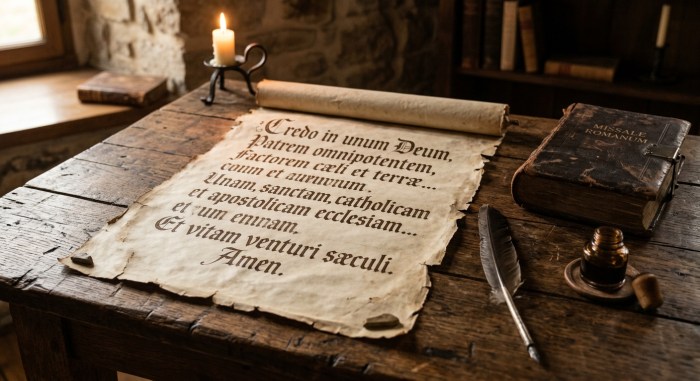
“I BELIEVE in God the Father Almighty, Maker of heaven and earth: And in Jesus Christ his only Son, our Lord;
who was conceived by the Holy Ghost, born of the virgin Mary, suffered under Pontius Pilate, was crucified, dead, and buried; he descended into hell; the third day he rose again from the dead; he ascended into heaven,
and sitteth on the right hand of God the Father Almighty; from thence he shall come to judge the quick and the dead.
I believe in the Holy Ghost; the holy catholic church; the communion of saints; the forgiveness of sins; the resurrection of the body; and the life everlasting. Amen”
At the time I considered this to be all “dead religion.” It was like reciting the pledge of allegiance each day at school. It seemed to lose its meaning and became only a rote regurgitation. It also seemed to me that there were perhaps those who thought that this appeased or pleased God in someway, leading to “points” for heaven, or helping them to get into heaven. No one ever told me why we said it, we just did. As a young inquisitive teenager I decided that this had NO place in my Christian walk. We must keep it real, not just recite dead creeds.
Authority of Creeds
It wasn’t until years later, almost twenty-five, that the Lord led me to learn more about Christian history. As I did, I learned why they had created these creeds. Most occurred before the canonization of scripture, that is before the Bible as we know it came into being. At that time, all that existed of the New Testament were letters and Gospels that had circulated for years among churches and believers. But there was no standard accepted text as we know it today.
As a result, many heresies and wrong teachings arose that taught the opposite of the Bible or a slightly twisted version. In response, the early saints developed Creeds to counter these heresies and to preserve what they understood as true and pure doctrine.
In these creeds, truth was preserved so that it didn’t get lost. For without the truth, men cannot believe and be saved. Jesus said, “you shall know the truth, and the truth shall set you free.” The Truth He spoke of was not just any truth, but the truth of who He is, the Son of God, our Messiah, who came to redeem us from our sins. Knowing this, trusting and clinging to this, is what saves us.
The word “creed” comes from the Latin word “credo,” which means “I believe.” Creeds never precede faith, but presuppose it. The Church is not founded on symbols but on Christ; not on any words of man, but on the word of God; yet it is founded on Christ as confessed by men, and a creed is man’s answer to Christ’s question, “Who do you say that I am?” (Matthew 16:15-16) 2.
Whenever controversies arose concerning the true meaning of Scriptures in the early Church, it became necessary to formally express their true sense, to guard it against error, and to regulate the public teaching of the Church. Peter gave the first confession, or creed, when he responded to Christ’s question to the disciples of who they believed Him to be by saying, “You are the Christ, the Son of the living God” (Matthew 16:16).
It followed that the teaching of the original Apostles, along with the teachings of Jesus, as expressed in the writing of the four Gospels, was to become the basis of all sound teaching and doctrine. Whenever, therefore, any of these teachings were contradicted, in even the smallest iota, it became known as a heresy, and was refuted by the leaders, using the authority of the known writings of the Apostles.
Heresy Arises in the Church
As I dug deeper into these historical roots, I began to realize that the creeds were never meant to be a mindless ritual. They were born out of a desperate struggle for survival. The early church was suddenly forced to translate the life-changing message of Jesus into a hostile, philosophically complex world, and things quickly got messy. As the Gospel clashed with the world, persecution became an ever increasing reality.
In the first three centuries, the church found itself in a hostile environment. On the one hand, it grappled with the challenge of relating the language of the gospel, developed in a Hebraic and Jewish-Christian context to a Graeco-Roman world. On the other hand, it was threatened not only by persecution, but also by ideas that were in conflict with the biblical witness.
With the death of the original apostles, heresies began to arise among the church. This was not unexpected (2 Peter 2:1; 1 John 4:1), because the apostles themselves battled heresies. Heresy, in the first century, was seen as any person or group who had a differing opinion than the majority or traditions, and was not approved by the rest of the religious body. By the beginning of the second century the mainstream body of Christian doctrine was forming and was either followed, or attacked, by various differing religious groups. Heresy, however, cannot exist or occur, unless there is first an established orthodoxy—a standard system of beliefs accepted by the majority.
In the first four centuries of the church, the letters of the Apostles, at that time referred to as the “Memoirs of the Apostles”, were circulated by teachers who used to gather pupils around themselves. These teachers would often establish churches, not in the building sense, because buildings were not seen until the end of the third century. There was much confusion among the early schools and teachers, and not everything done in the church was accurate.
Heresies, however, as divisive and volatile as they were, provided the maturing church with a great service, forcing certain guidelines to be drawn, and boundaries set against going too far into tradition or paganism. An example of this can be seen in Marcion, who rejected the Old Testament as well as the Gospels of Matthew, Mark, and John, forcing the church to draw up a New Testament canon.
Throughout Christian history, the predominating heresies were mostly around the Person of Christ and who He really was, mostly surrounding His deity. The volatility of these heresies led to much conflict in the church. Concerning this one issue of the deity of Christ were no less than eight different heresies debated, accepted by some, and rejected by others within the early Christian church.
In A.D. 312, Constantine won control of the Roman Empire in the battle of Milvian Bridge. Attributing his victory to the intervention of Jesus Christ, he elevated Christianity to favored status in the empire. “One God, one Lord, one faith, one church, one empire, one emperor” became his motto.
Furthermore, Constantine saw the state as the “bearer” of religion to the world. He had received Christianity, not through the church, but, as he proclaims, from Christ himself, in a vision, and, therefore, God had placed the emperor—and thereby the empire as well—under the protection of the Cross and in direct dependence on Christ. (Alexander Schmemann, The Historical Road of Eastern Orthodoxy [New York, St. Vladimirs Seminary Press, 2003], pg. 80.)
The new emperor soon discovered that “one faith and one church” were fractured by theological disputes, especially conflicting understandings of the nature of Christ, long a point of controversy. Arius, a priest of the church in Alexandria, asserted that the divine Christ, the Word through whom all things have their existence, was created by God before the beginning of time. Therefore, the divinity of Christ was similar to the divinity of God, but not of the same essence.
Arius was opposed by the bishop, Alexander, together with his associate and successor, Athanasius. They affirmed that the divinity of Christ, the Son, is of the same substance as the divinity of God, the Father. To hold otherwise, they said, was to open the possibility of polytheism, and to imply that knowledge of God in Christ was not final knowledge of God. (Quoted from The Constitution of the Presbyterian Church (U.S.A.), Part I, Book of Confessions; Geneva Press, Louisville, KY.,1996, by the Office of the General Assembly, Presbyterian Church).
Nicene Creed
The Nicene Creed, as we know it today, came into existence as the result of three church councils. The first council, the Council of Nicaea, was held in A.D. 325, and called together by Constantine himself in hopes to resolve the rifts within the church. The basic form of the creed came into being when Eusebius of Caesarea suggested that they use, as a starting point, the creed which his own see used as a baptismal declaration. It had been passed down through several generations and he asserted that it was the teaching of the apostles themselves. The emperor and the council agreed, and it formed the basis of the original Creed. Few changes had to be made; however, they secured the deity of Christ by declaring him to be “of one substance with the Father,” thus, overriding the Arians.
Unfortunately, the resulting creed did not bring the enduring peace to the church as was hoped. A second council convened in A.D. 381 in Constantinople, which resulted in securing the deity of the Holy Spirit as an equal part of the Trinity. Some of these changes were already part of the Common Book of Prayer at that time, but were added to the Creed to form most of what we know today as the Nicene Creed. The Eastern Orthodox Church accepted this creed, and still uses it to this day.
The Latin, or Western, form of the creed differs from the Eastern form by only one phrase, known as the Filioque, which created one of the biggest schisms between the Eastern and Western churches, besides the Pope. The Filioque phrase was added during a third council, the Council of Toledo, A.D. 589.
To complete the victory over Arianism, the phrase “and the Son”, was added to show the Spirit proceeding, not just from the Father, but from the Son also. This secured the deity of each part of the Trinity. The Eastern Church did not receive this addition, even to this day, but the Western churches have embraced it, though some had expressed opposition at the first.
The Nicene Creed has stood the test of time as the most universally accepted creed. The Apostles Creed, however, is the most widely recited creed in the Western churches. It got its name, not because it was written by the Apostles, but because it was a summary of their teachings.
The Eastern churches, however, never accepted that creed. The sheer brevity and accuracy of the Apostles’ Creed made it useful for baptismal declarations, as well as catechetical instruction. It was the Nicene Creed, however, that provided the necessary doctrines to combat the critical heresy’s, preserving the deity of each part of the Trinity, in a concise, easy to understand form.
A New Era
Today, we have the Word of God in so many different forms, printed, audio, and video. It has been well preserved over the centuries, and the truth is available to us anytime we want it. However, we rarely take the time to read it and truly “seek Him with all our hearts” as we are called to do. With so much information coming at us today, the truth gets easily lost or twisted or shielded or forgotten. And unfortunately, because we serve a god of convenience in our western world, it is too much trouble to search for truth. In fact, we’ve become so naive as to believe almost anything we see on the big screen or on the internet.
In addition, Christians today have too often yielded their responsibility to learn the truth to the pastor or Sunday School teacher. They say that it is “their job” to study and learn, while everyone else goes on with life. Then we can just sit for an hour or so a week and let them tell us what they learned. We can grunt with approval or disapproval and go home.
In our house church, we have chosen to use the Nicene Creed–the most widely accepted creed in Christendom even today. Interesting to note is that the New Testament was being assembled at the same time, and the doctrines of the Nicene Creed were used to help put it together, while at the same time the New Testament scriptures, as we know it, helped create the Nicene Creed. Our house church chose to use this creed because of its wide acceptance and its accuracy. Some of our group have committed it to memory. And although we don’t recite it each time we get together, we do so on occasion as a reminder of the basic doctrine of our faith.
Recently, one of the young men in our fellowship was called on the carpet by one of his friends to state what he believed. He was with a group of his friends, and all were challenged at that moment to state their faith. The young man in our fellowship shared that he simply stated the beliefs of the Nicene creed, reciting it and expounding where necessary. No one else in the group knew where to begin, except that they believed in Jesus. Needless to say, they were all quite shy after that, as they really were not equipped to defend their own beliefs, much less even state them.
I was quite proud of our young brother for boldly stating and defending his beliefs. He stated how confident he felt when he was able to do so with ease and certainty. He also impressed the one who questioned him. In essence, the creed, when used properly, is a powerful tool to help us know and understand what we believe as Christians–what is sound, pure, foundational faith.
I guess we can always just say “we believe the Bible,” but so many claim they believe it, but aren’t on the pathway to heaven, for their beliefs may not be the truth, as the Bible is often twisted to mean what folks want it to say.
Conclusion
Just as the early believers needed an anchor to keep from drifting into cultural compromises, twenty-first-century Christians face a strikingly similar crisis. Back then, the danger was a lack of standardized scripture; today, the danger is the exact opposite. Today, so much information bombards us that truth gets easily scrambled and jumbled. We need something accurate and concise and the creeds are just that.
In essence, we live in an increasingly post-Christian era, and fewer and fewer people are exposed to sound doctrine and Christian faith. Perhaps the creeds of old will once again be revived to help us know what we believe and then to explain to a lost world what the Truth of the Gospel is.
The authority of creeds is not to be confused with the authority of Scripture, however. The creed, at its best, is a relative and approximate confession of the revealed truth of Scripture. The Bible is the authority behind the creed, which is never seen to be of equal status with the Bible.
It is effective only as much as it accurately reflects the true revelation of the Bible. It is intended to be a concise expression of the already accepted truth of God’s Word, confessed by its adherents. They are summaries of the essential doctrines of the Bible, uniting its professors in a common bond, and guarding against false doctrine and practice. They are profoundly useful in the instruction of new followers, and distinguish the Church from the world, and truth from heresy.
“The creed, when used properly, is a powerful tool to help us know and understand what we believe as Christians—what is sound, pure, foundational faith.”
What will the church do in this age of information to preserve and defend sound doctrine? Will we overcome the “god of convenience” that we have served for so long, and take this new challenge seriously? Or, heaven forbid, will we get lost in the oceans of information, allowing God’s truth to blend with worldly thought and religions and misguided philosophies?
I propose that the authority of creeds today has in no way diminished, in fact it has increased. It is even more important to have a standard as we learn to sort out fact from fiction, and truth from heresy. The creeds, like the Nicene Creed, can help us do this, giving us a tested standard by which we can measure against the pounding waves of information saturation.
Fortunately, we have a promise that “heaven and earth will pass away, but My Word will never pass away.” And history has given us the creeds to help us preserve God’s Truth through His people. Will you be one of them?
Bibliography
- 1Shaff, Philip; The Creeds of Christendom, Baker Books, Grand Rapids, MI, reprinted 2007, pp. 4-9.
- 2“Heresies of the Early Church”, Lecture One, Arkansas Institute of Holy Land Studies.
- 3Pritchard, Ray; Credo; Crossway Books. Wheaton, IL. 2005. pp. 11-25.
Categories: Ekklesia Community


Leave a Reply