This podcast is a conversation summarizing key concepts of the Priesthood of All Believers from this article and others on this site. It is not an audible version of the following text.
Introduction
There is a priesthood that no one seems to be talking about anymore. It began a long time ago and continues to this day. It is spoken of in the holy scriptures. It still exists today yet ever so quietly, and is overlooked, and even forgotten, by most in the modern Church. But it was established by God himself at the beginning of time and operates under God’s direction even now. It is known as the “priesthood of all believers.” But what is meant by the “priesthood of all believers?” Why would God make all His followers priests?
When you hear the word “priest,” a flood of visions and preconceptions may come rushing into your mind. These may vary based on your religious experiences. In many cases, the priestly image that may prevail is of a person with a black suit and a white collar, who carries out religious activities in a church service, whose entire life is given over to leading others within a religious community through teaching and performing certain rituals. They may have a title like “reverend” or “father” or “bishop” or something similar to indicate their special role for all who address them.
The “priesthood of all believers” is a doctrine found in scripture, not by that name, but by concept. The doctrine was obscured, however, as the Church became more and more institutionalized, even to the point of being completely abandoned. How many today would know about this essential doctrine, much less understand what it is and its implications in the life of every believer? It seems to be hidden because the impact of its application would change the face of the church as we have come to know it.
It is important to note that the priesthood of all believers is not a goal to be attained. It is a present reality. God has made you a priest if you are in His Kingdom! The moment you cross over into God’s Kingdom through trust in Jesus, you receive the Holy Spirit and are, at that moment, a priest in His Kingdom. When a baby is born into a family, they immediately become a full member. They are not yet to the point of understanding what that means, nor able to operate fully, but in time they will be able to. However, they are still very much a full member of the family.
Likewise, in God’s family, we are born into it through our trust in Jesus, and we become a full member with all the privileges and responsibilities. Though we still grow up and mature in the faith, we, nevertheless, are still fully part of His family. So, too, we are priests of God from the moment that we are born into God’s family, even though we may not yet understand what that means nor how to live that out.
The priesthood of all believers has been so cleverly forgotten and suppressed that very few grow to operate in it. But God’s plan doesn’t change, nor does His will. As we shall see, God had planned from the beginning to make us His very own representatives.
Where in Scripture?
When you read the book of Revelation, you don’t get very far before the author makes this very interesting statement, “He has made us a kingdom of priests for God his Father” (Revelation 1:6). Likewise, in chapter 5 he states,
“And you have caused them to become a Kingdom of priests for our God, and they will reign on the earth” (5:10).
One more time, at the end of Revelation, John refers to those who have been raised as part of the first resurrection just prior to the thousand-year reign of the Messiah, that “they will be priests of God and Christ and will reign with him a thousand years” (20:6b). Since this is stated three times at the end of the Bible, we can see that the Lord has purposed the followers of Jesus to be priests. The text does not differentiate between followers but simply declares that they are priests. The use of the word “kingdom” in relation to the priestly claim certainly emphasizes that there are not just a few, but a whole kingdom of them. What else could he mean but that every true follower of the Lord has entered into this priestly role. If it’s that important to our Lord so as to mention it three times in Revelation as a stated fact, then it is a topic that we should be discussing, but even more importantly, we should be living it out and embrace it as part of the identity and the role that the Lord gave us when we entered into His Kingdom.
The book of Revelation is not the only time this priesthood is referenced. In fact, the first time in scripture that we see a reference to a kingdom of priests is in Exodus 19, where the Israelites, who had just been rescued from slavery in Egypt were gathered at the foot of Mount Sinai. There God declares to them,
“You have seen what I did to the Egyptians, and how I carried you on eagles’ wings and brought you to myself. Now if you will pay careful attention to what I say and keep my covenant, then you will be my own treasure from among the peoples, for all the earth is mine, and you will be a kingdom of priests for me, a nation set apart” (Exodus 19:4-6).
We see a similar reference in the New Testament letter written by Peter, where he quotes this passage, yet he is referring to the followers of the Messiah, Jesus. He tells them
“But you are a chosen people, a royal priesthood, a holy nation, God’s special possession” (1 Peter 2:9a).
I don’t see evidence in scripture that Israel ever fully grasped the scope of this role that they were given, but when Jesus came and, through the Cross, brought new followers into the fold, both Jews and Gentiles, the same priestly role became theirs as well, and likewise our own as followers of Jesus today.
From the Beginning
In the beginning, in Genesis, we see that God created humanity in his own image (Genesis 1:26-27). An image is a representation of the original. We, as God’s creation made in His image are His representatives1. Furthermore, when God put Adam and Eve in the Garden of Eden and told them to “cultivate and care for it, he used the same words that were later used to characterize the work of priests. We will discuss this more below.
Critical to this is that priests are always at work wherever the presence of God meets the earth. Eden was that place. In the Garden, Adam and Eve met with the Lord daily. He walked with them. We see this in Genesis 3 after they had eaten the forbidden fruit:
“When the cool evening breezes were blowing, the man and his wife heard the LORD God walking about in the garden. So they hid from the LORD God among the trees” (Genesis 3:8).
Of course, from that verse on we see that they were thrown out of the Garden, out of the presence of God, because of their disobedience, and their priestly work ceased. Humanity had lost the privilege of being in God’s presence, and although they retained certain elements of the image of God, they could no longer reflect him because that image was marred by their own disobedience. Furthermore, humanity ceased doing God’s work and focused only on themselves. This is a tragic result of our fall into sin.
The Mystery of Melchizedek
The first time we see the word “priest” used in the scriptures is in Genesis 14:18,
“And Melchizedek king of Salem brought out bread and wine; now he was a priest of God Most High.” (Bold font mine)
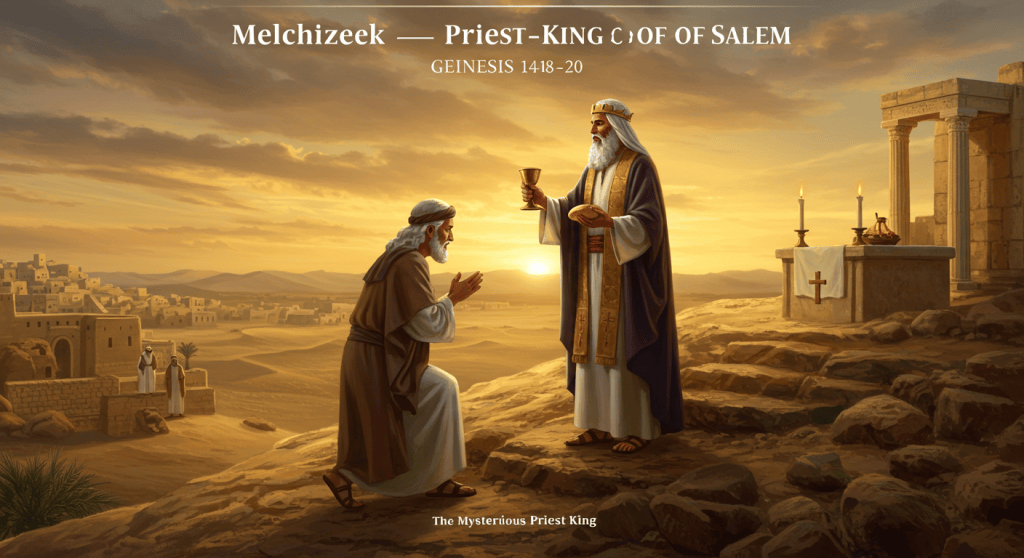
Since the word “priest” is not defined in the text, the writer must have assumed that the reader would already understand what a priest is. From the context we can tell that he was a representative of God. Abraham recognized him as such, and was so convinced so, that he gave a tithe of all the goods he had obtained from his victory over the kings who had taken his nephew Lot and family. He recognized that God had given him the victory.
The existence of Melchizedek indicates that the priesthood is not determined solely by ancestral lineage as it was in the Levitical priesthood. For the writer to the Hebrews states that he is without a lineage, in that we don’t know his family, where he originated from (Hebrews 7:3). But Abraham recognized him as one of God’s priests. The scriptures do not elaborate on this, but perhaps it is not necessary, for Abraham’s response to him is all we need to realize that he was sent by God.
A Veiled Separation
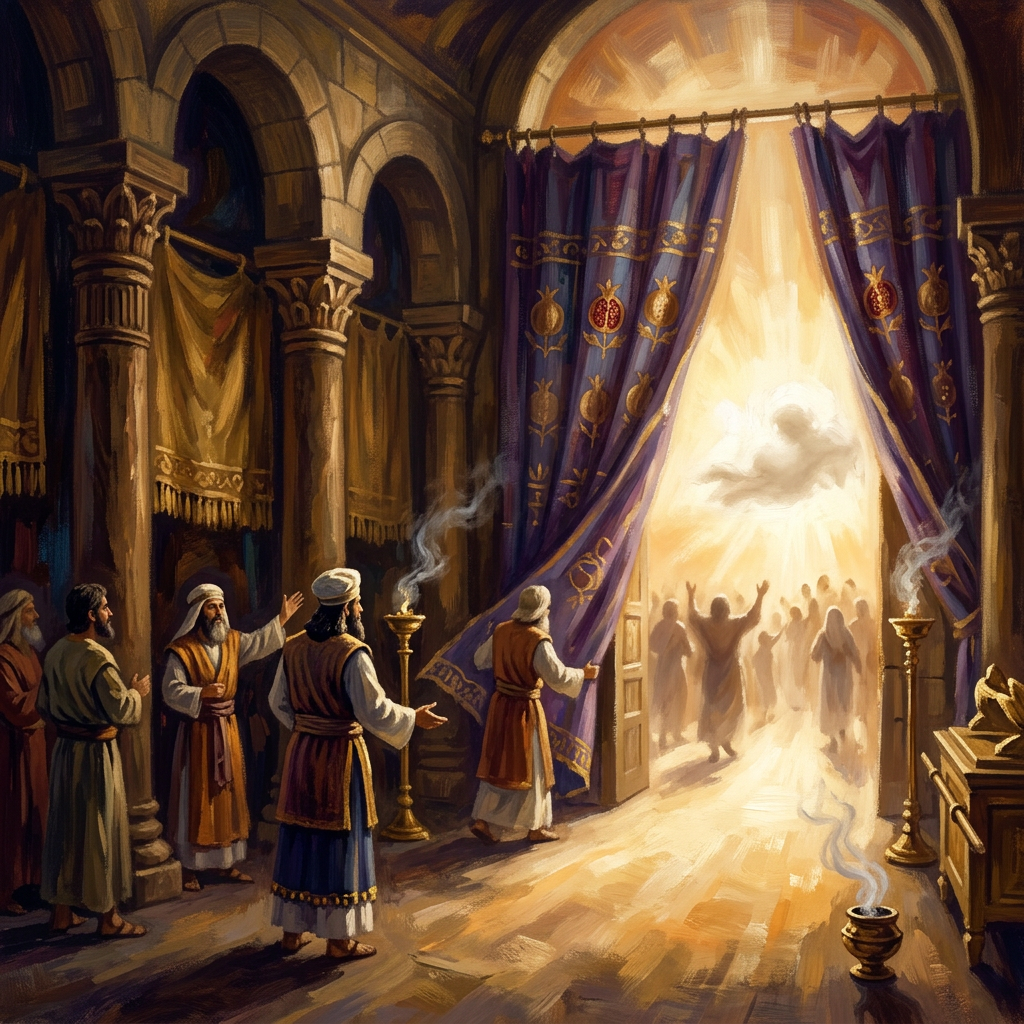
Centuries later, as recorded in the book of Exodus, we see the Lord establish a priesthood over the nation of Israel. He instructs Moses to assemble the materials to build a tabernacle, an elaborate tent, where the priests would perform their duties. Key to this tabernacle was the inner-most room where the presence of the Lord would dwell. This room was different because a heavy veil hung over the only doorway into the room, making it off limits to everyone but the High Priest. According to Leviticus 18, the High Priest was the only one allowed to go into the Holy Place where God’s presence dwelt, and he could only go once a year. He had to explicitly follow God’s directions that Moses recorded. He could not go in whenever he wanted to, or he would die (Leviticus 18:1). No ordinary person could go into this room, for the Ark of the Covenant was in there and the presence of God resided there as well.
Once the tabernacle was constructed, Moses dedicated it, as well as Aaron and his sons as priests. When this occurred, the glory of the Lord descended onto the Tabernacle as a cloud. So thick was the cloud that Moses and the priests could not do anything within the Tabernacle (Exodus. 40). The presence of God descended and dwelt in the midst of His people, guiding them wherever they went. At night it appeared as a fire, and by day it was a cloud. When the cloud lifted, the people would pack up their camp and follow the cloud to where it would stop. There they would set up their camp again.
So, God made a way to begin the process of dwelling with his people once again by dwelling in the tabernacle, and later the Temple. Surely, as Solomon states, no building can contain God (1 Kings 8:27), but His holy presence came to dwell in the midst of the Israel camp, even though contained in such a confined place. Adam and Eve were thrown out of the presence of God because of their sin, thus all humanity was blocked from entering God’s presence because of their sin. Fallen, unholy humanity cannot exist in the presence of a holy God. The veil in the tabernacle served as a continual reminder of the holiness of God in contrast with the fallen, unholy, nature of humanity.
The role of the other priests was to offer animal sacrifices on behalf of individuals who brought animals to the Tabernacle to be sacrificed. These sacrifices were to be made only at the Tabernacle as an atonement for the sins of the people.
First, it was the Tabernacle, and later the Temple, a more permanent structure, where God’s presence dwelt, where heaven and earth met. We get a glimpse of this at the dedication of the Tabernacle, in Exodus 40, when the presence of God appeared in a cloud and showed that He was pleased with the completed work. That same presence was seen when the Temple was dedicated by Solomon in the land of Israel as recorded in 2 Chronicles 7.
God’s desire, however, has always been to dwell with his people unveiled and unhindered. A new way was needed.
A New and Better Way.
Things changed, though, when Jesus came and offered himself as a sacrifice on the Cross. It was His sacrifice that the writer to the Hebrews calls the “perfect sacrifice” (9:14, 23). It was that sacrifice that provided a perfect cleansing from our sin (Hebrews 10:1-3). As a result, Hebrews 10:10 tells us that
“For God’s will was for us to be made holy by the sacrifice of the body of Jesus Christ, once for all time.“
There was no longer any need for priests to offer animal sacrifices for sins. The sacrifice of Jesus was enough for all.
At the moment Jesus died, Matthew tells us that “the veil of the Temple was torn in two from top to bottom” (Matthew 27:51). This veil was the large heavy veil that separated the Most Holy Place, the room where the presence of God dwelt, from the rest of the Temple, as spoken of above. In essence, it is what separated humanity from the presence of God. It was this veil that was miraculously torn from top to bottom at the moment that Jesus died. This event was more than symbolic, a sign, and not by accident. It was not done my any human, but supernaturally. This was an act of God, and it indicated that the veil was no longer needed because the sacrificial blood of Jesus was sufficient to atone for the sins of humanity. Since animal sacrifices were no longer needed, there was no longer even a need for the Temple and the Holy Place where atonement for sin was made each year. Furthermore, there was no longer any need for a veil to separate God from his people because Jesus’ sacrificial blood made it possible for God and humanity to once again dwell together. In fact, all those who would put their trust in the sacrifice of Jesus to atone for and remove their sins and be His follower would become the new dwelling place of the Lord, because we can be made holy because of Jesus’ blood, and with our sins and trespasses forgiven and removed, a holy God can now dwell in our bodies. Peter says,
“you yourselves, as living stones, are being built into a spiritual house to be priests set apart for God” (1 Peter 2:5a).
The indwelling presence of God in His followers is a preparation for their priesthood. This is something that the Israelites did not have. They had the law, which was external, written on tablets of stone given to Moses on Mt. Sinai, but they did not have the indwelling Spirit of God, the law written in their hearts. God himself knew the limitations of this and said so through the prophet Jeremiah,
“This is the covenant I will make with the people of Israel after that time,” declares the Lord. “I will put my law in their minds and write it on their hearts. I will be their God, and they will be my people” Jeremiah 31:33.
That is why Peter, in the second part of chapter 2, verse 9, can say,
“that you may declare the praises of him who called you out of darkness into his wonderful light.”
This was the plan of God all along. Ever since the Garden, God wanted to reestablish an unveiled relationship with humanity so that He could dwell in our midst. This was made possible only because of the blood sacrificed by Jesus on the cross. Just before Jesus died, he spoke the words, “It is finished.” This would not make any sense to the casual observer. But Jesus had finished the work that God sent Him there to do–to atone for the sin of humanity. God saw that His sacrifice was enough to make that atonement. That important work was finished. Hebrews tells us
“And when sins have been forgiven, there is no need to offer any more sacrifices (Hebrews 10:18)
And yet again,
“Therefore, let us offer through Jesus a continual sacrifice of praise to God, proclaiming our allegiance to his name” (Hebrews 13:15).
This is part of the priestly work that we are to do, to declare the praises of God, letting all who will listen know that He called us out of the darkness of sin and despair and into the light of the truth, where we found peace and joy. This same opportunity is open to all who willingly come to Him. This is a priestly role, to bring God to those who do not know him, to make known to the world who the one true living God is.
The old priesthood was determined by the blood of Aaron, but the new priesthood is determined by the blood of Christ. The old priesthood had a written law, but the new one has the Law written in their hearts. The old priesthood could only serve at the Tabernacle or Temple location, but the new priesthood can serve anywhere and is the new Temple or Tabernacle (1 Cor. 6). God’s presence is no longer limited to a room behind a veil in a single location but now resides in every Jesus follower who are released to go throughout the entire world. Although we may not know that we are priests of God, we unknowingly perform priestly functions whenever we live according to God’s ways.
The Turn Towards a Clergy System
By the end of the first century, most of the original apostles had died, except maybe John. So, as the second century unfolds, the disciples of these apostles begin to come to the forefront and begin making decisions regarding the affairs of the church. Not far into the second century, Ignatius, the second Bishop of Antioch, who it was said was a disciple of John, wrote several letters on his way to Rome to be martyred by being thrown to the beasts in the Roman colosseum. In his letter to the Magnesians, he declared, “As therefore the Lord did nothing without the Father, being united to Him, neither by Himself nor by the apostles, so neither do ye anything without the bishop and presbyters. For every such thing is sinful and opposed [to the will of] God.” He put emphasis on the authority of spiritual leaders and the need for obedience to them. He went so far as to say that as Christ obeyed his Father, so we are to obey the bishops. In essence, this laid the foundation for a two-class system in the church–clergy and laity. It appears that Ignatius’ intentions were good and well meaning. He wanted to protect the churches from false teaching and false prophets that were becoming ever so prevalent. However, a power class took root, and the church has never recovered from this.2
The Early Church Fathers
The early church fathers spoke some about the priesthood of all believers but did not use that specific term. The term “priesthood of all believers” was a title that came out of the Reformation in the 16th century. However, the early church fathers spoke more generally of the priestly duties of all believers.
For instance, Justin Martyr in the second century viewed the “incense” that is offered by believers not as a literal smoke, but as prayers and hymns. In the same century, Irenaeus of Lyons wrote in his work “Against Heresies” that “all righteous possess the sacerdotal rank.” He held that priestly living was lived out in righteousness and devotion, which all believers could do.
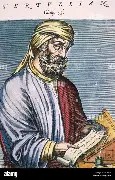
Tertullian in the third century, when referring to the believers, wrote “Are not even we laics priests?” He argued that when no ordained clergy were present, a layman could administer the sacraments (like Baptism and the Lord’s Supper elements), however, the authority of the bishops should be maintained for the sake of ecclesiastical order.
From just these few examples we can see that already the rise of a clergy in the church had begun to usurp the priesthood of all believers. In fact, they held the belief that although the believers are part of a universal priesthood, there is a ministerial priesthood that should preside over the Eucharist, Baptisms, and maintain apostolic order and succession.4
That belief still exists today, and it developed as a necessary addendum to preserve the authority of the clergy while acknowledging the biblical doctrine of the universal priesthood of believers. In However, I would argue two things against this reasoning: First, the only professional priesthood found in the Bible is in the Old Testament, not the New Testament. These priests, however, rotated their service weekly, on a twenty-four week schedule (1 Chronicles 24). One would be hard pressed to find anything resembling clergy as it developed in the teaching and works of the apostles. Secondly, the mere presence of the clergy in the church has so completely eclipsed the authority of the universal priesthood of believers that it has all but ceased to exist in practice, and modern believers have little to no understanding of this vital biblical doctrine but instead submit solely to the authority of the clergy.
This model has predominated into modern times. The clergy and laity lines remain in tact, and laity are not encouraged to seek God apart from the church institution or clergy instruction for fear of heresy. Laity are led to believe that they cannot survive spiritually apart from the oversight (or covering) of the authority of the clergy.
Constantine and Later
In the fourth century, the emperor Constantine legalized Christianity and began to establish church buildings as official places of worship, clergy as the official leaders of the church, church services that regulated how to worship, and holy days that established when to worship. And from that point onward, the power of leadership in the church steadily increased.
It didn’t take long before the clergy became intoxicated with the power of positions, controlling even crowns, Kingdoms, and the common people. They declared that they alone had God’s approval and knew His will for all others. Laity had no say and were totally subject to the direction of the clergy. In many cases, laity were kept ignorant, as services (mass) were held in languages like Latin, unknown to the commoner. Even singing in the church was permitted only by the professional singers. Laity were complete spectators in the process. This was the darkest time for the church, and, one might add, for the world, also. For the true light of God for the world had been hijacked by the hunger for control and power. Even historians call this era the Dark Ages. And indeed, it was. Still today, many clergy discourage people from seeking God on their own or even reading scriptures apart from clergy direction.
The Reformation and Beyond
The corruption of the Dark Ages came to a head in the late fifteenth and early sixteenth centuries. The Roman system had their own priests that they put forth as the only priesthood. Furthermore, because the Word of God was not available to the common people, and was often cloaked in Latin, a language only the elite and the learned could read, common believers were prohibited from reading what God had intended for them.
With the invention of the printing press in the fifteenth century, however, all this began to change. One could say it was the birth of the information age. Suddenly books and knowledge began to be made available to the common people. Bibles, too, were translated into the language of the people and distributed for all to read, sometimes at the cost of the life of the one who printed it. But it revolutionized life as a whole. It made information more readily available because it was more easily reproduced, faster than ever before. Previously, only the elite controlled the production of books and they were very expensive, so the poor could not access them. But with the new technology of printing, society as a whole was transformed by the increased information flood that followed. Likewise, the Reformation was fueled by the availability of writings by Martin Luther and others.3
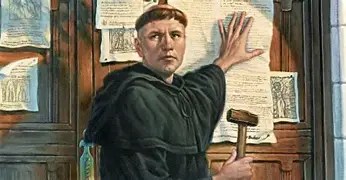
Unrest with the Roman Catholic system became increasingly prevalent. Many writings that came from the new printing press stoked the furnace of discontent of the common person who soon became aware that the teachings and practices of the Church were not according to scripture. The “shot heard round the world” came when Martin Luther posted his 95 Theses on the chapel door at the University of Wittenberg on October 31, 1517, with the intent of starting a discussion around sin and repentance, although there were many non-biblical practices occurring at the hands of the clergy at that time that were mentioned in his post. The post ignited a firestorm revolution that became known as the Protestant Reformation. Many left the Roman Catholic church to form new congregations. These protesters became known as Protestants. One of the key doctrines that was revived out of that movement, was the Priesthood of All Believers. It was one of the central doctrines promoted by Martin Luther, and it was a reaction to the highly hierarchical authority of the Roman Catholic church and the Pope, which Luther insisted was not founded in the New Testament.
Post-Reformation churches rejected the authority of the Roman Catholic system, and adopted a more simplified hierarchy of their own. Though they clung to the doctrine of the Priesthood of all Believers, it was soon obvious that they struggled to know how to truly implement it. Worship services were still run by ordained clergy, who were responsible for the spiritual life of the church community. Laity were now allowed to sing and participate in the service through liturgy and common prayer, but spiritual direction was given by the clergy as God’s representative. The belief of the early church fathers remained strong, that there are two priesthoods–that of the universal priesthood of all believers and a ministerial priesthood.
The Critical Nature of the Priesthood of All Believers
Why is the Priesthood of All Believers doctrine so critical? In order to understand this we need to see how it is a vital result of the fulfillment of the plan of God that has unfolded throughout the ages. When we see what God is working to accomplish through time, as it is unveiled in scriptures, it becomes clear that the universal priesthood is indeed an indicator of the work that God is completing not only in the world, but in the lives of individual followers. So when did all this begin?
The Garden as a Temple
We can go all the way back to the beginning of Genesis, when Adam and Eve were in the Garden with God. It is obvious to the casual reader that the Lord was preparing them to be rulers of the entire earth. For He states, “Be fruitful and increase in number; fill the earth and subdue it. Rule over the fish in the sea and the birds in the sky and over every living creature that moves on the ground” (Genesis 1:28). We do not see here any mention of the word “priest,” but the roles of Adam and Eve are established similarly. They were commanded by God to “work it and keep it” (Genesis 2:15). The two Hebrew words translated here, ” ‘abad” and “shamar” are the same two Hebrew words also used to describe the work of the priests in the Tabernacle as a form of worship. We see these words used many times in the book of Numbers to describe the work of the priests. Here, in the Garden, we have God dwelling with the new humans and giving them service to do.1 A priest is someone in direct connection with God that goes between him and creation or other humans. Adam and Eve walk with God unhindered in the Garden as a holy place. Since Adam and Eve were God’s representatives, they were the first priests, and their purpose was to keep and work the Garden.
The Israelites as the Priesthood
After the Israelites built the Temple, which became a more permanent form of the Tabernacle, they placed images of palm trees and open flowers, which were images of the Garden. This was important because humanity lost everything when they rebelled against God in the Garden. But God wants to reestablish what was lost, that unhindered fellowship that Adam and Eve experienced each day. The Temple was to reflect the nature of the Garden as the place where God and humanity are in fellowship together. It was the only place on earth where God’s presence could be found.
The nation of Israel was created to be a nation of priests. God told Moses in Exodus 19:6, “‘…and you shall be to me a kingdom of priests and a holy nation.’ These are the words that you shall speak to the people of Israel.” The people were afraid, however, to hear from God when they saw God’s presence in the fire and smoke on Mt. Sinai and heard his voice. Their response was predictable, for they “said to Moses, ‘You speak to us, and we will listen; but do not let God speak to us, lest we die'” (Exodus 20:19). God’s plan, however, was for the entire nation to act as priests for the rest of the world, teaching them God’s ways, and interceding for them. It was not to be, however, at that time.
We do get a prophetic glimpse of what is to come in the book of Numbers, chapter 11, where the Lord tells Moses to assemble the seventy elders, “people you recognize as leaders of the people and officers of theirs” (11:16) so that He can take some of the Spirit of God that rested on Moses and place it on them as well so that they can share the burden of carrying the people. All but two of the seventy gathered at the Tabernacle as Moses requested. When the Lord placed the Spirit on them, they prophesied. But even the two who did not make it to the Tabernacle, who were part of the seventy, began to prophesy as the others did. Joshua, Moses’ assistant, asked Moses to make them stop. However, “Moses replied, “Are you so zealous to protect me? I wish all of Adonai’s people were prophets! I wish Adonai would put his Spirit on all of them!” (11:29). We see this prophetic word fulfilled at Pentecost when the Holy Spirit was, indeed, put on all of God’s people!
If God placed His Holy Spirit on the elders of Israel in order to equip them to be leaders along with Moses, we too have a responsibility, as we bear His name and His Spirit, to carry the burdens of God’s work in our current world.
The New Priesthood Declared
Fast forward to the New Testament, a couple thousand years later, one of Jesus’ disciples, Peter, pens a letter to the believers of his day, both Jews and Gentiles, who had been dispersed. In it, he reminds them of the words spoken by God to the Jews on that Holy Mountain. He tells them they ‘like living stones are being built up as a spiritual house, to be a holy priesthood, to offer spiritual sacrifices acceptable to God through Jesus Christ (1 Peter 2:5). In a couple verses later he quotes Exodus directly, applying God’s words to a whole new generation, who had the law of God written in their hearts by God’s Holy Spirit, not on tablets of stone as on the mountain.
The Old Testament priesthood, as given to Moses by God in the Torah, ceased to function as it was intended when the destruction of the Temple in Jerusalem occurred in A.D. 70, only forty years after Jesus had returned to heaven. Why would God remove the Temple? Why would God remove these critical priestly roles so suddenly? Could it be that God had already prepared a replacement for them?
Jesus and His Disciples
We already spoke of the apostle John’s reference to the priesthood of all believers when he was on the island of Patmos where he penned the book of Revelation as a result of a vision from the Lord.
It is important to note that Jesus never spoke of a new clergy anywhere. In fact, just the opposite. He would make statements like “wherever two or three are assembled in my name, I am there with them” (Matt. 18:20). Or later, in Matthew 23 he instructs his disciples not to allow anyone to call them by traditional leader names:
“But you are not to be called Rabbi, for you have one Rabbi, and you are all each other’s brothers. And do not call anyone on earth ‘Father’ because you have one Father, and He is in heaven. Nor are you to let yourselves be called ‘leaders,’ because you have one Leader, and he is the Messiah! The greatest among you must be your servant, for whoever promotes himself will be humbled, and whoever humbles himself will be promoted” (Matt. 23:8-12).
It certainly appears that Jesus was directing his disciples in a new pathway that did not include clergy type leaders as was common in His day.
Likewise, when we see Paul and the disciples setting up new faith communities, they do not appoint clergy. Paul instructs Titus to appoint elders (plural). George Eldon Ladd, in his New Testament Theology notes the plurality of the elders set up by the apostles which was in similar fashion to the synagogue of the day5. There is little to no instruction as to what these elders were to do. Timothy mentions the act of communicating the Gospel and teaching. Peter calls on them to be examples and to shepherd the believers, watch over and protect them, but not to lord authority over them (1 Peter 5:1). Paul refers to himself as a parent to the Corinthians (1 Cor. 4:15, 2 Cor. 12:14-15) and also to the Thessalonians (1 Thess. 2:11) and even Timothy (1 Tim. 1:2). Apparently, he uses this term toward those he was responsible to lead to become followers of Jesus, and to those who he has some spiritual responsibility toward. He never asserts himself as being in charge of them, or lord over them. As parents, we raise our children to leave the home and begin a life and family of their own. Paul expected that his “children” would do likewise.
It is also interesting to note that when Paul was writing his letters to the various churches, he does not write them to “the pastor” of such and such a church, or even the elders alone of a church. Rather, he writes the letter to the entire church. He only includes the elders in the introduction one letter, that to the Philippians (Philippians 1:1). But all the rest are addressed to the entire church as the intended recipients of the message the he is sending.
So, it seems that Paul and the twelve disciples all understood that Jesus was replacing the old priestly structure with a new one. It may not have been evident at first, but surely after Pentecost when the Holy Spirit was given to all, it can be seen that the new priestly structure includes everyone who follows Jesus. If the Holy Spirit can possess God’s Spirit, then anyone could be led by Him, could represent Him, and could do His work.
Paul emphasizes that Christ alone is the Head of his Body, the Church (Colossians 1:18). And he later states “From him the whole body, joined and held together by every supporting ligament, grows and builds itself up in love, as each part does its work (Ephesians 4:16). In his first letter to the Corinthians, he breaks down what some of the work of the different parts is. It is the Holy Spirit that gives gifts to the people assembled and works through each part of the body to build up the whole body. Paul never instructs only one person to edify the entire assembly. Instead, he sums up what should occur when followers are gathered:
“What then shall we say, brothers and sisters? When you come together, each of you has a hymn, or a word of instruction, a revelation, a tongue or an interpretation. Everything must be done so that the church may be built up.”
1 Corinthians 14:26 NIV
This is God’s design. He desires to possess all His people and to speak through them to build others up and to make himself known to a lost world.
Conclusion: Why a Priesthood of All Believers?
Why would God want to establish every believer as a priest? We must keep in mind that the purpose of God since the foundation of the world was to dwell with his creation, mainly humanity. He did so without hindrance in the Garden of Eden, however, after the Fall a separation between God and humanity happened immediately. They were banished from His presence in the Garden (Genesis 3:23-24), and God spent the rest of history restoring that relationship and removing that barrier so that once again, we could dwell together unhindered. He started with one man, Abraham, and built from him a nation. He dwelt in their midst but only behind a thick veil in the Tabernacle and later the Temple. But Jesus changed all that. He came in human form but was limited to time and space. But even He stated that God is Spirit, and therefore, is not limited to time and space. Because of Jesus’ sacrifice, death, and resurrection, the Holy Spirit can now dwell unhindered within all who have been cleansed by the Blood of Jesus’ sacrifice by faith. As His Temple and His priests, we are now instruments in His hands to continue His mission to reconcile the world back to himself.
Bibliography
1https://bibleproject.com/articles/were-adam-and-eve-priests-eden/
2Library : The Seven Epistles Of St. Ignatius Of Antioch | Catholic Culture
3The Printing Press & the Protestant Reformation – World History Encyclopedia
4 Shelley, Bruce L. Church History in Plain Language, 4th Edition, Thomas Nelson, 2013, pp 76-77.
5Ladd, George Eldon. “A Theology of the New Testament (Revised Edition).” Grand Rapids, Michigan: William B Eerdmans Publishing Company, 1993.
Categories: Ekklesia Community, Kingdom of God, Uncategorized


Leave a comment