See the Bible Reading schedule below to download.
Reading through the entire Bible can be a challenge! I write about my experience a bit in The Whole Story. It has been the greatest faith deepening and growth activity that I have ever done. But it’s very easy to get side tracked without a schedule. There are so many schedules available out there, but I put one together in a unique manner to help bridge related scriptures to give context and greater meaning and understanding. The one below is the one I have personally used for several years. If you complete a line each day you will read through the entire Bible in less than a year. But I specifically designed this without dates, so that you can use it any time of the year and you can go chronologically, setting your own schedule.
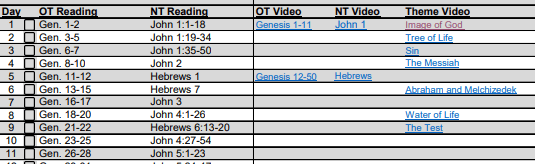
In the left column are the Old Testament and New Testament readings. In the right column are links that take you directly to a Bible Project video that covers the book being read or a topic being discussed in the reading. If you use this document on your computer or phone, the links should work to take you directly to the video. If you choose to print it out, use the video name to find it at the Bible Project website if you want to view it. This is not comprehensive list of videos, because new videos are coming out each year. Feel free to explore at bibleproject.com.
What’s Different About This Schedule?
In creating this, I wanted to tie certain scriptures together for greater unit. For example, David wrote some Psalms that we know applied to certain events. When those events are read in the narrative, the New Testament reading may be replaced with the psalm that David wrote that applies to that event. Likewise, in 1 & 2 Kings there may be a sudden jump to a minor prophet that was speaking at the time of the occurrences in the Kings narrative. It is more practical to read those prophecies in light of the events rather than reading them several weeks, or months, later with no reference to what was going on.
In the New Testament, I rearranged the epistles (letters) closer to the order in which they were written, as we understand it today. Also, certain books of Paul or James were written during the Acts events, and so we will jump to the letter, then back to Acts, which gives context to what Paul and the other authors were penning their letters about.
I welcome any feedback, even suggestions, on how to make it better. If you find errors feel free to let me know as well. Enjoy!

