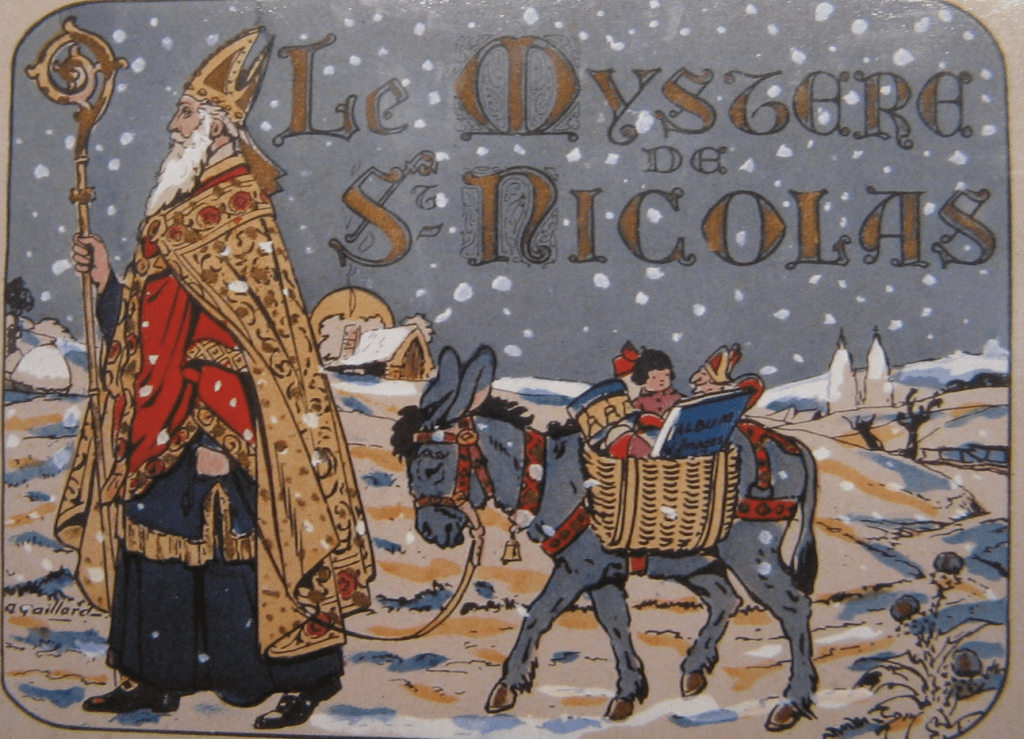
St. Nicholas was born in Patara, Lycia, an area in present day Turkey, around AD 280. Having lost both his parents at a young age, he used his inheritance to help the poor and sick. He was a devout Christian and later became bishop of Myra, a city now known as Demre. Little was written about his life, therefore many legends and stories have traveled through history and nothing certain is known. He lived during the time of Constantine. He is presumed to have been captured by Diocletian, the Roman emperor known for his persecution of Christians, and later released when Constantine took over.
He became the bishop of Myra. It is possible that he even attended the first Council of Nicaea in AD 325, where he struck the heretic Arius in the face. In the Catholic Church he became the patron saint of children. He was known for his generosity and kindness. One common account is that of a poor man with three daughters. Due to their great poverty, the father would have to sell them into slavery or prostitution. On hearing of this, St. Nicholas visited one night and secretly left enough gold for a dowry for one of the daughters to get married. On two subsequent nights, he left gold enough for the other two daughters to do likewise. It was on the third visit that the father saw him and thanked him.
St. Nicholas remained a popular saint throughout Europe, with many churches named after him. He was also popular in Switzerland and Russia. He was said to have died on December 6, 343. Hence, December 6 is known as St. Nicholas day.
In the middle ages his popularity was at its height. During that era, the Saints were the heroes of the day. After the Reformation, however, when veneration of the Catholic Saints went by the wayside, St. Nicholas, too, was almost forgotten, except in a few countries like Holland and parts of Germany. There he was commonly known as “Sinterklaus,” the Dutch equivalent of Saint Nicholas. On the eve of St. Nicholas day, children would put their shoes outside the door of the house, and St. Nicholas was said to come by and put things in their shoes. Children would awaken to chocolate coins or oranges, the most common gifts. Candy canes, which were in the shape of a bishop’s crosier, or pastoral staff, were also given. St. Nicholas was said to arrive on horseback in his red suit, the color of his bishop robe.
These traditions were carried by the Dutch to the new world in the 17th century, to New Amsterdam, known today as New York City. By the 19th century, Sinterklaus traditions had spread and became Santa Claus in the English speaking American colonies. Santa Claus was eventually combined with the Christmas holiday, and in the 19th century he was given more magical powers, as he was combined with Nordic legends and given a sleigh with reindeer.
In the winter of 1822, Clement Clark Moore, an Episcopal minister and father of six children, was sent to the store by his wife to get a turkey that the family would then donate to the poor. It was that wintry night, as his children played by the fireplace, that he got an inspiration to write a poem, and went into his study and wrote what we know today as “‘Twas the Night Before Christmas.” The next year, the poem was sent to the newspaper by a friend of Clement with the understanding that the author’s name would not be published because he was too humble to take credit for its writing. It was first published on December 23, 1823. The poem was an instant success and became extremely popular! The newspaper printed it every year at Christmas time. It would be twenty years before Moore took credit for authoring the poem.
Later that century, Thomas Nast, a popular political cartoonist, drew on Moore’s poem and created an image of Santa Claus with a heavy cheerful man with a full white beard, holding a sack full of toys for children. Nast also gave Santa his red suit trimmed in white fur, North Pole workshop, and a wife, Mrs. Claus.
As Christians in the twenty-first century in the Western world, we see the commercialization of Christmas and how St. Nicholas was changed to a secular magical figure. But the lessons we learn from the life of St. Nicholas, what little we know of him, are that he lived a life of giving to the poor, especially the poor children and other disenfranchised of his day. As we approach the Christmas season, we may get swept up in the traditions of our culture, but we can still tell the stories of how things began, and we can recapture in our own lives and families the essence of the meaning of their origin. As St. Nicholas honored His Lord by helping the poor, so we are reminded of Jesus’ words to us when he said,
“Whenever you give a luncheon or dinner, do not invite your friends , your brothers, your relatives, nor wealthy neighbors, otherwise they may also invite you to a meal in return. That would be your repayment. But whenever you give a banquet, invite people who are poor, who have disabilities, who are limping, and people who are blind; and you will be blessed, since they do not have the means to repay you; or you will be repaid at the resurrection of the righteous” (Luke 14:12-14).
And,
“Take care not to practice your righteousness in the sight of people, to be noticed by them; otherwise you have no reward with your Father who is in heaven. So when you give to the poor, do not sound a trumpet before you, as the hypocrites do in the synagogues and on the streets, so that they will be praised by people. Truly I say to you, they have their reward in full. But when you give to the poor, do not let your left hand know what your right hand is doing, so that your charitable giving will be in secret; and your Father who sees what is done in secret will reward you (Matthew 6:1-4).
Categories: Uncategorized
 Beyond Traditon
Leave a comment